

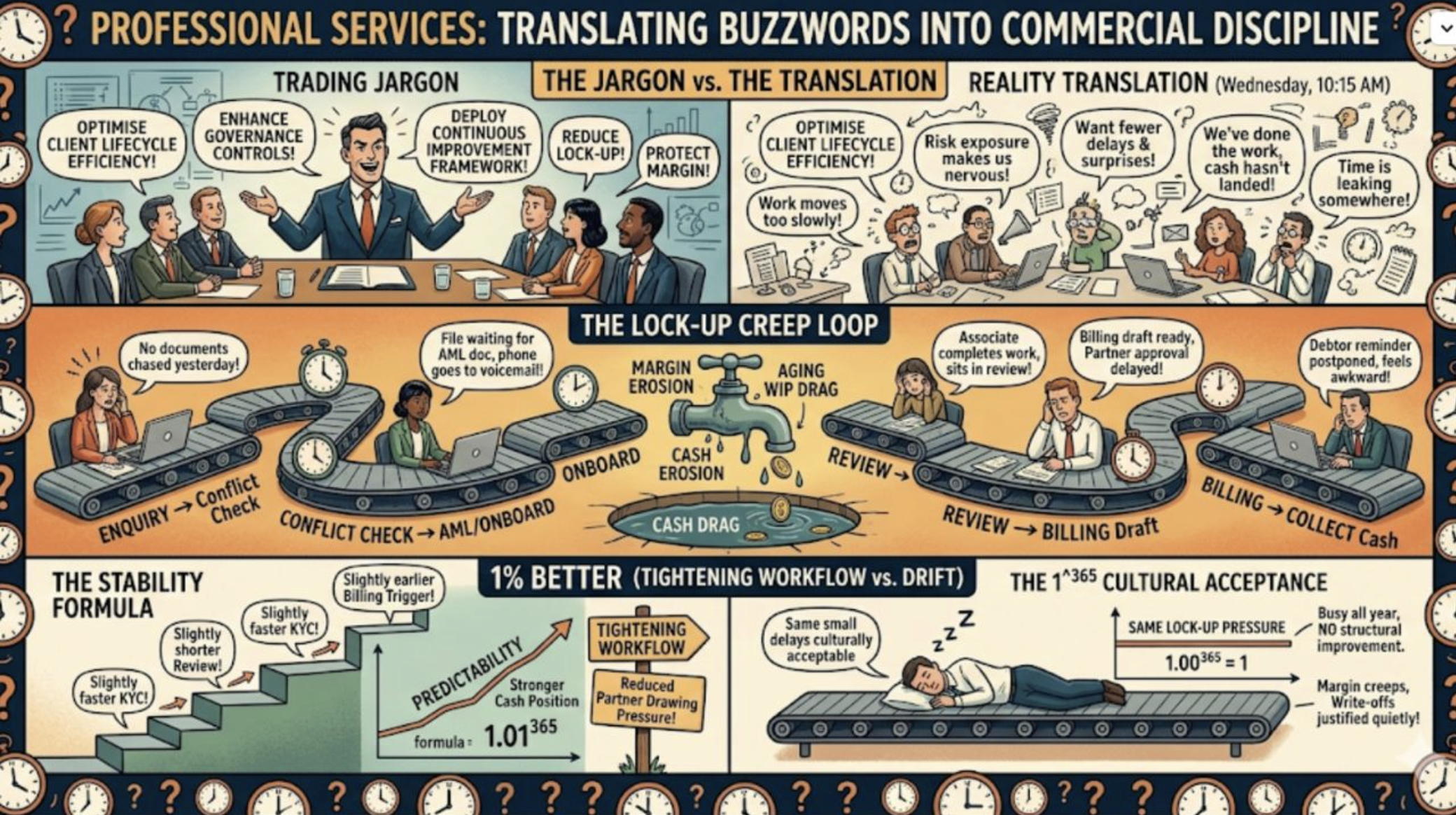
On a completely ordinary Wednesday, the phone rings and goes to voicemail because everyone is "in meetings." An onboarding file is waiting for AML documents because no one chased yesterday. An associate completes work and it sits in review. A billing draft is ready but partner approval hasn't happened. A debtor reminder is postponed because it feels awkward to send.
Everyone is busy, but work is waiting. That waiting - that space between effort and payment - is your operating model, whether you have consciously designed it or not.
Your Operating Model Isn't a Diagram
Most firms think an operating model is a diagram in a deck. In reality, it is simply how work moves, who owns each step, how long decisions take, what authority exists, when billing is triggered, how cash is collected.
- Law FirmEnquiry → conflict check → AML → engagement → work → review → bill → collect
- AccountancyOnboard → gather data → process → review → file → bill → chase
- BankingApplication → KYC → risk → approval → offer → completion → monitoring
Every delay inside that chain stretches lock-up.
- LeanCalls that waste
- Six SigmaCalls it variation
- FinanceCalls it aging WIP
- ClientsCall it slow
Continuous Improvement Is Just Workflow Discipline
Continuous improvement is not a programme you launch - it is the discipline of tightening workflow. Lean, in this context, simply means removing unnecessary waiting between steps. Six Sigma means reducing unpredictable variation inside those steps.
In day-to-day operations it shows as:
- Why does one onboarding take five days and another take fifteen?
- Why does one partner review within hours and another within days?
- Why does billing trigger immediately in one team and monthly in another?
This is not industrial thinking - it is operational clarity.
Technology Won't Fix a Slow Workflow
There is a natural reflex right now to look to technology - automate onboarding, introduce AI-assisted review, digitise billing workflow. Technology absolutely helps, but if no one owns follow-up, if approval authority is unclear, if billing waits for habit instead of trigger, if decisions escalate unnecessarily - then AI will not fix the flow. It will simply visualise the delay more clearly.
Technology scales behaviour. If behaviour is slow, automation scales slow. Operating model discipline fixes behaviour.
The Real Meaning of the 1% Improvement Idea
Improving by 1% does not mean revenue increases by 1%. If review time reduces by 1%, turnover does not instantly rise. If billing cycle shortens by 1%, fees do not jump.
What improves first is predictability - WIP age stabilises, billing timing becomes more consistent, lock-up variability reduces, utilisation becomes easier to plan.
When people talk about getting 1% better, what they really mean is tightening small, controllable elements of workflow consistently.
That is not a revenue formula - it is a stability formula.
Small improvements compound. Smoother workflow, lower aging WIP, stronger working capital timing, fewer write-offs.
1.00³⁶⁵ = 1. Busy all year. No structural improvement. Same lock-up pressure. Same cash drag.
Control What You Can Control
There is already enough you cannot control:
- Regulatory tightening
- AML scrutiny
- FCA or SRA oversight
- Market volatility
- Fee pressure
- Response time standards
- Clear ownership of each step
- Review turnaround expectations
- Billing triggers at completion
- Debtor follow-up cadence
Margin Rarely Disappears Dramatically
In financial and professional services, margin rarely collapses overnight - it erodes quietly.
- Lock-up creeps by a few days
- Debtor days stretch slightly
- Write-offs become easier to justify
- Cash flow tightens
- Partner drawing conversations become uncomfortable
The question isn't whether you have a continuous improvement framework. The question is: is your workflow tightening - or drifting?
Are you shortening the time between doing the work and getting paid - or managing the symptoms of delay?
There is already enough outside your control. Control what you can - deliberately, consistently.
That's not improvement theatre. It's commercial discipline.
If this resonates, always happy to have a conversation.