Continuous Improvement Training, built around what your team needs to fix.
Some teams ask for Lean Six Sigma because that's the improvement language they know.
They might need that route, or they might need a focused set of tools taught properly through the work in front of them.
We begin with what people need to fix, not the name of the course they think they need.
One tool, several tools, or a practical combination shaped around the problem.
Your examples, your language and your operational reality are built into the training.
The full toolkit is available. You don't have to take all of it. We scope the skills gap, choose the right tools and build the training around your examples, your terminology and your people.
It's not always which course to buy.
It's what capability is missing. Some teams don't need a full methodology pre-packaged for them. They need the right tools taught properly, through the problems they already face.
People cannot see the real process
They know their bit, but the full flow, handoffs and waiting time are not clear.
The same problem keeps coming back
Teams are fixing symptoms because they have not been trained to find the cause.
Every team does it differently
The work relies on habit, memory or individual preference instead of a clear standard.
Waste is hard to challenge
People are busy, but nobody has given them a simple way to spot what should not need to exist.
Measures don't drive action
The numbers are there, but they are not helping people make better decisions in the work.
Improvement ideas don't land
People want to improve things, but they need structure, practice and confidence to move forward.
“We don’t need our team to be Green Belts. We need them to be able to map a process, find a root cause and fix it. Can you just teach them that?”
Yes. That's exactly what this is.Same toolkit. Specific to what your team needs to fix.
This isn’t a smaller version of Lean Six Sigma and it’s not a training catalogue.
It’s the improvement toolkit, shaped around the capability gap in front of you.
We can teach one tool in a half-day session.
We can combine several tools into a practical programme, or build capability around a live problem your team needs to solve.
James can take any tool from the full improvement toolkit, strip it to what matters and teach it in a way that lands in a warehouse, boardroom, store, practice, factory or service team.
Amy brings the human side of how people learn, practise and adopt new ways of working, so the training feels practical rather than academic.
The tools may be standard. The session never is.
No two sessions should feel the same because no two businesses have the same people, pressures, examples or problems.
We scope the need
We understand what people need to do differently and where the current skills gap is showing up.
We choose the tools
We select the practical tools that fit the issue, rather than taking people through the whole framework by default.
We build it around you
Your sector, terminology, examples, forms, handoffs, measures and pressure points shape the session.
People practise it
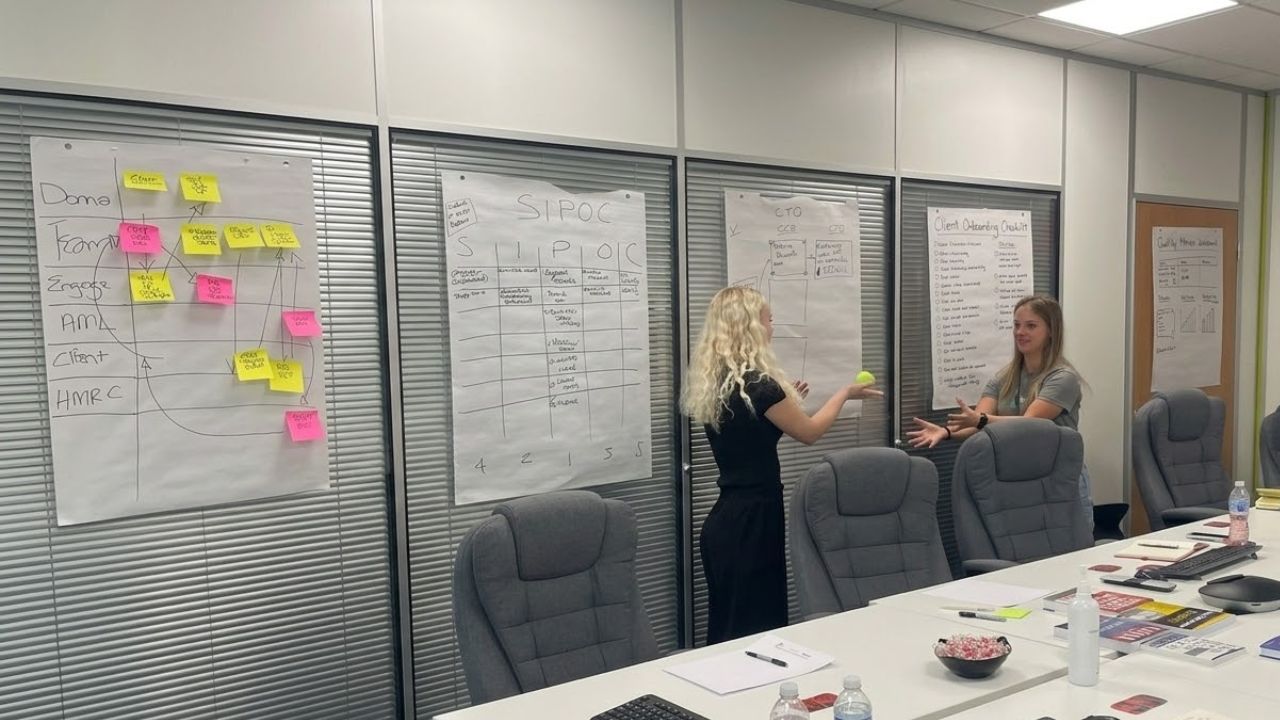
We use drawings, examples, simulation and discussion so people can use the tool when they leave the room.
The toolkit is flexible. The training is shaped around the need.
Use this as a guide, not a self-diagnosis. You don't need to know the answer before we speak. It shows how targeted the training can be.
Useful when: People are unclear on how the work really moves.
What it helps people do: Map the real process, surface handoffs, waits and rework, then agree what good should look like.
- Where does the work start and end?
- Where does it wait, loop or get checked again?
- What version are people actually following?
There are many more scenarios where a tool not listed here may help your teams.
Get in touch to discuss your bespoke requirements. We can build exactly what you need, when you need it.
When people need improvement skills, not necessarily a full belt route.
This is often the right place to start when the business knows capability is missing, but doesn't want to force everyone through a programme that is bigger than the problem.
They ask for Lean Six Sigma because that's the language they know
We help you work out whether they need a recognised belt route or the targeted tools behind it.
A specific skills gap is slowing improvement down
Teams may need process mapping, root cause, visual management, standard work or waste identification more than a full framework.
You have changed the work and need people to sustain it
Operating Model, Process Improvement and Cost Reduction work all last longer when people have the skills to keep improving.
Practical tools become practical capability.
The result isn’t people who can name the tools. It’s people who can use them to improve the work in front of them.
People can see the real work clearly.
Teams learn how to turn messy work into a clear view of steps, handoffs, waits, loops and ownership, so improvement starts from evidence instead of opinion.
CI Training in practice.
Both examples were built around the specific tools the teams actually needed, not a standard programme forced onto the business.
From training to real operational impact
A UK manufacturing business needed its operational team equipped with practical CI skills. The programme was built around the work people actually needed to improve.
- Three cohorts of ten people, delivered over focused two-day sessions
- Bespoke curriculum shaped around live operational problems
- Practical tools applied in the room, not left as theory
From toolkit to shared capability
135 colleagues were trained across central functions, with the training built around the tools, examples and working patterns people needed to apply.
- Shared improvement language without making it terminology-heavy
- Examples built around central function work and real team challenges
- Capability created across teams rather than held by one specialist group
Targeted CI Training can make every other fix stronger.
When people know how to use the right tools, improvement doesn't have to keep coming back to the same few leaders.
Process Improvement
The process gets fixed, then people have the tools to keep checking and improving it.
Operating Model
The model becomes easier to sustain when people understand the routines and standards behind it.
Cost
Reduction
Recovered cost? Trained teams can keep spotting the next round of waste and avoidable effort.
Lean Six Sigma Training
Need White, Yellow or Green Belt certification? That’s the full recognised route. This is the targeted toolkit route.
Let’s build the training around what your people need to use.
Book a scoping call and we’ll work out whether you need one tool, a combination of tools, Continuous Improvement Training, or the full Lean Six Sigma route.