

It's March. The new plan deck is live: "FY25 Transformation Programme."
We've got AI-driven demand forecasting, a new store operating model, a regional restructure, tech-enabled stock accuracy, a Summer trading reset, a cross-functional steering group and operational excellence governance.
This year will be different. It has to be - because the last ten restructures clearly weren't.
- A delivery arrived late and sat in the backroom until peak
- A customer left because their size wasn't on the rail
- A team member spent six minutes finding a handset
- The rota didn't match footfall again
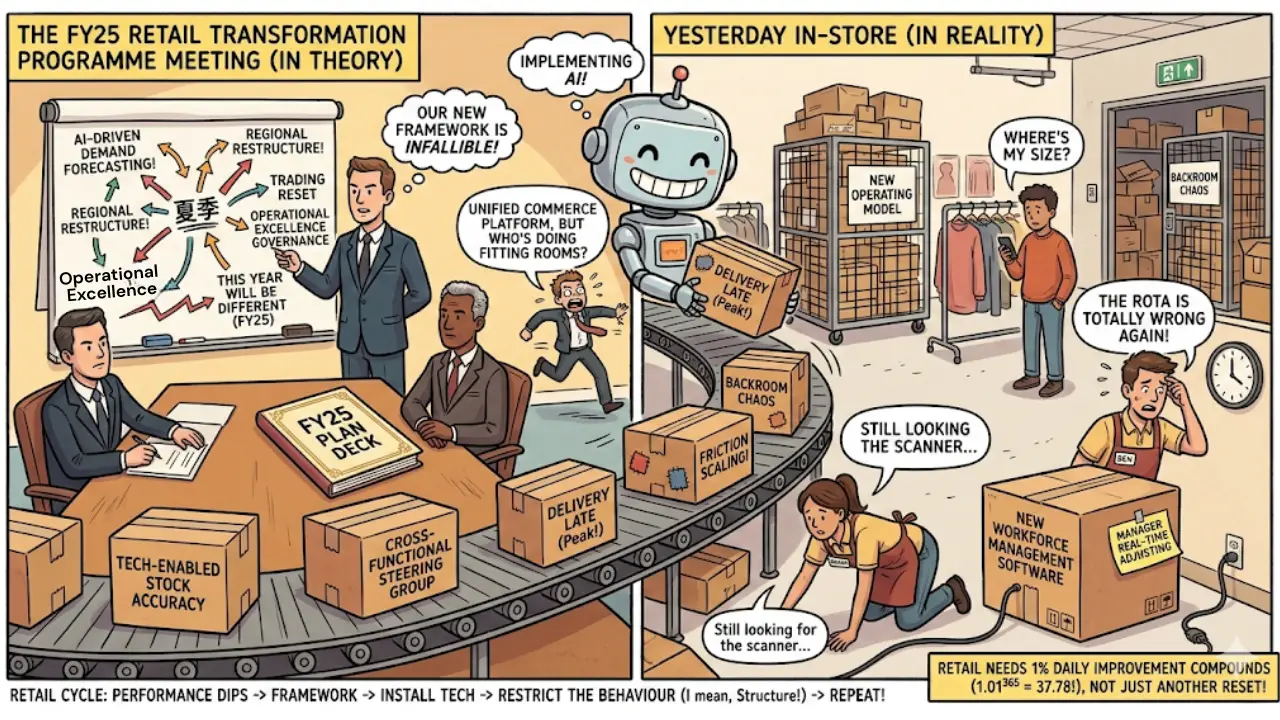
Retail has a cycle.
Performance dips - so we introduce a framework. It doesn't move fast enough - so we install technology. When that doesn't fix behaviour, we restructure.
Technology amplifies behaviour - it doesn't replace it.
If friction is unmanaged, tech scales friction.
Retail loves a reset - Spring refresh, Summer trading push, Back-to-school relaunch, Golden quarter strategy, January bounce-back.
Every season gets a theme, but the same issues quietly carry over:
- Stock in the wrong place
- Unclear accountability
- Backroom inefficiency
- Decision-making stuck between functions
Then comes the restructure:
- New reporting lines
- Fewer layers
- More accountability
- Clearer ownership
- Flatter hierarchy
"This time we've fixed the operating model."
You can redraw reporting lines. You cannot restructure daily behaviour.
If store managers still escalate simple fixes - if buying and stores still operate in silos - if accountability flows upward but autonomy doesn't flow downward - then the friction survives the restructure. It just gets new email addresses and new reporting lines.
Where the Friction Actually Lives
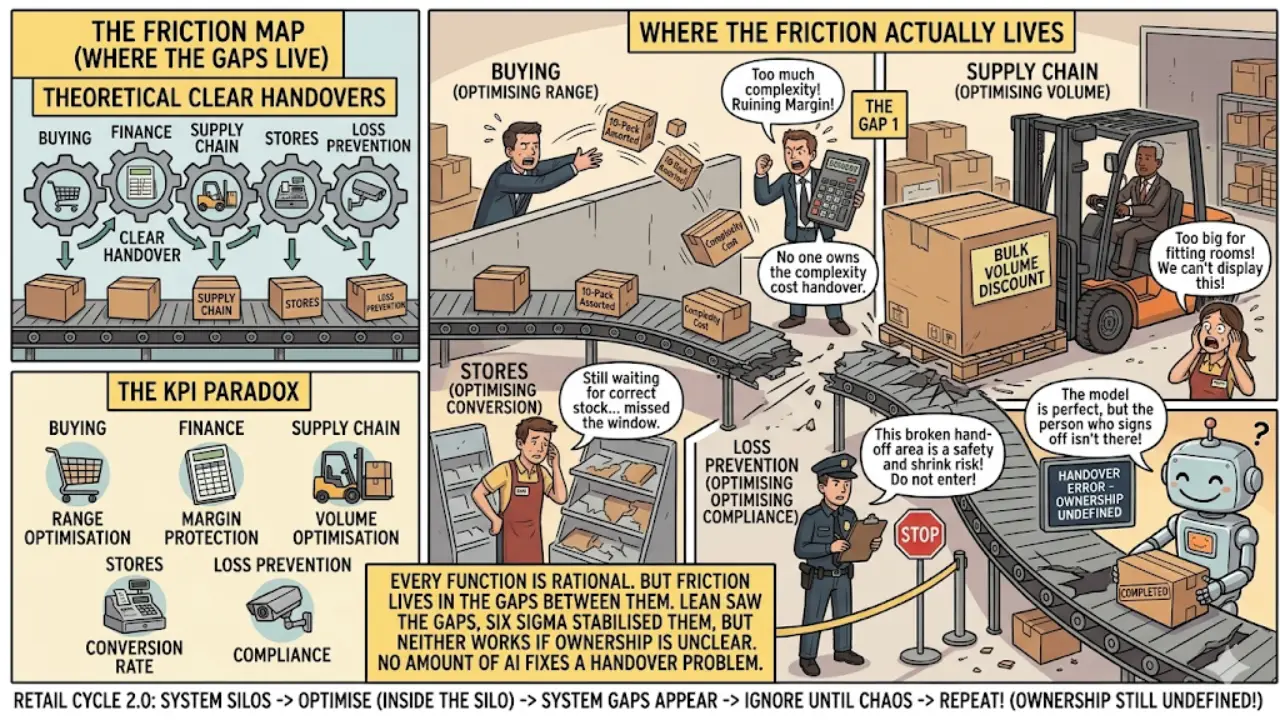
Retail is complex - multiple functions, multiple KPIs, multiple reporting lines, multiple systems, multiple pressures.
- Buying optimises range
- Finance protects margin
- Supply chain optimises volume
- Stores optimise conversion
- Loss prevention optimises compliance
Every function is rational. But friction lives in the gaps between them.
Lean was built to see those gaps. Six Sigma was built to stabilise variability inside them - but neither framework works if ownership is unclear. No amount of AI fixes a handover problem.
Here's what doesn't make the transformation slide.
If today one store tightens backroom flow by 1%. If tomorrow replenishment timing improves by 1%. If the next day staffing alignment improves by 1%.
They may all be small, boring, local impacts - but by making a 1% improvement every day, 365 days a year, those stores get 37.78% better over the course of the year.
That's compounded operational control - but it requires autonomy. It requires someone at the point of friction to say "we're fixing this now." Without waiting for:
- The next seasonal reset
- The next system rollout
- The next restructure
- The next AI pilot
Unless:
Otherwise? It will be the same friction - with better dashboards, smarter forecasting and a new org chart.
Retail doesn't need another reset. It needs disciplined, daily removal of friction where cash is actually getting stuck.
Are we investing in technology and restructures because it feels decisive - or are we empowering teams to remove 1% of waste every day?
Only one of those compounds. If this tension feels familiar, that's exactly the space we work in - not anti-tech, not anti-structure, but pro-ownership and pro-daily movement.