

(It's Not Where You Are Looking)
(It's Not Where You Are Looking)
When a business decides it needs to reduce cost, the conversation usually starts in the same place - headcount, marketing spend, travel budgets, maybe some supplier conversations about whether a better rate exists.
Those aren't the wrong places to look...but they are the visible places. The most expensive cost in most businesses isn't sitting neatly on a P&L line - it's buried in how the business actually operates.
-
1Labour Deployed Against the Wrong WorkNot too many people - the wrong people doing the wrong things at the wrong level. Roles over-specified for the task. Shift patterns built around a demand profile that no longer reflects reality. Overtime absorbed as a normal operating cost because the underlying resourcing was never recalibrated after growth changed the shape of the work.
-
2Supply Chain and ProcurementMost businesses have supplier relationships that have not been genuinely reviewed in years. Contracts that auto-renewed without negotiation. Consolidated spend that has never been leveraged. Pricing agreed when the business was a different size, for a different volume, under different market conditions. That isn't the supplier's fault...it's a conversation that was never had.
-
3Consumables and MaterialsUsage creeping above specification. Waste embedded in production or service processes that has become invisible through familiarity. Purchasing habits inherited from whoever set up the process originally and never questioned since.
-
4Utilities, Facilities and OccupancySpace and energy costs benchmarked against what was agreed when the business was configured differently. Leased space that made sense three years ago and makes significantly less sense now.
-
5Technology and SubscriptionsOverlapping tools. Unused licences. Platforms bought to solve problems that were subsequently solved another way, now sitting on the books drawing a monthly fee because nobody has had time to review the technology stack.
-
6The Cost of Poor QualityRework, returns, complaint handling, inspection and correction. The cost of things not being right the first time - not just the direct cost, but the management time, the customer experience impact and the operational disruption that compounds every time something has to be done twice. This is the most expensive and the least visible category in almost every business we work inside.
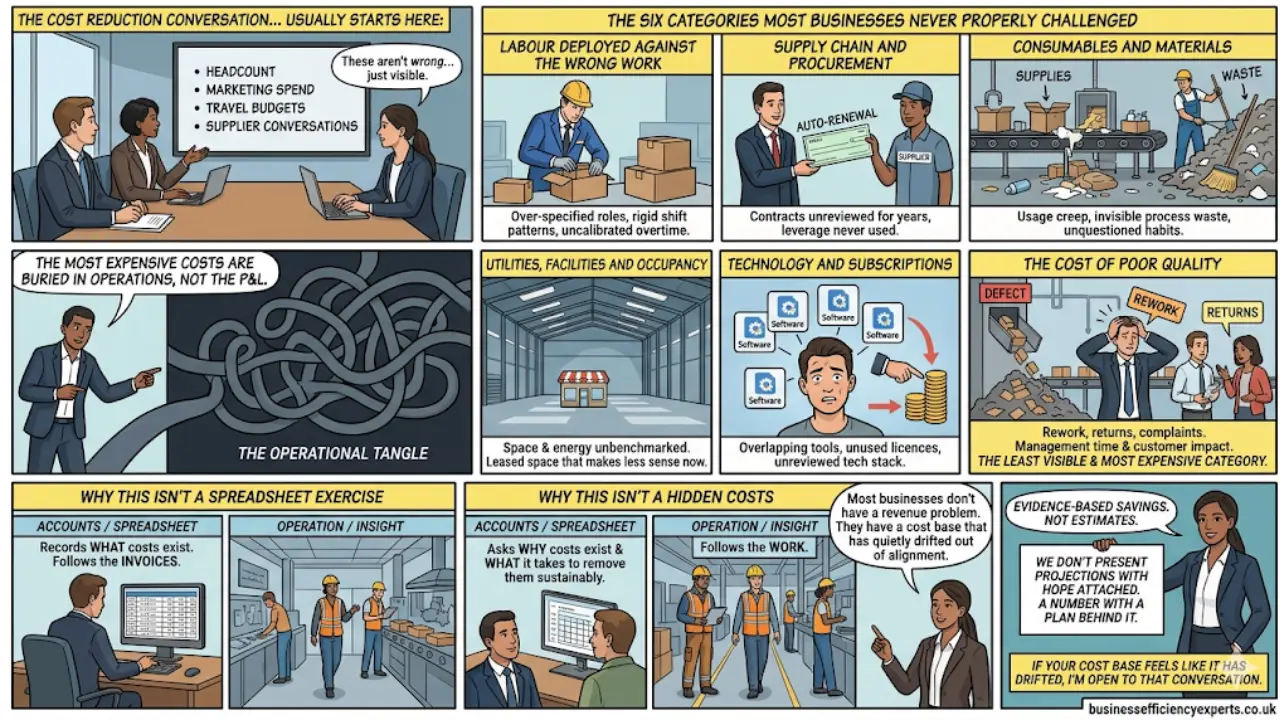
- A spreadsheet can record what costs exist. It can't tell you why they exist, whether they need to exist or what it would take to remove them sustainably.
- Real cost reduction requires someone to go into the operation, not just the accounts.
- To follow the work, not just the invoices.
- To ask questions that have not been asked before and to be willing to hear answers that challenge assumptions which have been in place for years.

We don't present estimates. Every saving we identify is evidenced before it is presented. A number with a plan behind it, not a projection with a hope attached.
The savings exist...the question is whether anyone has gone looking for them properly.
If your cost base feels like it has drifted and you want a clear view of where it actually is, that conversation is always worth having.
businessefficiencyexperts.co.uk