

"We tried improving that in 2014. It didn't work." - as if change has a warranty period.
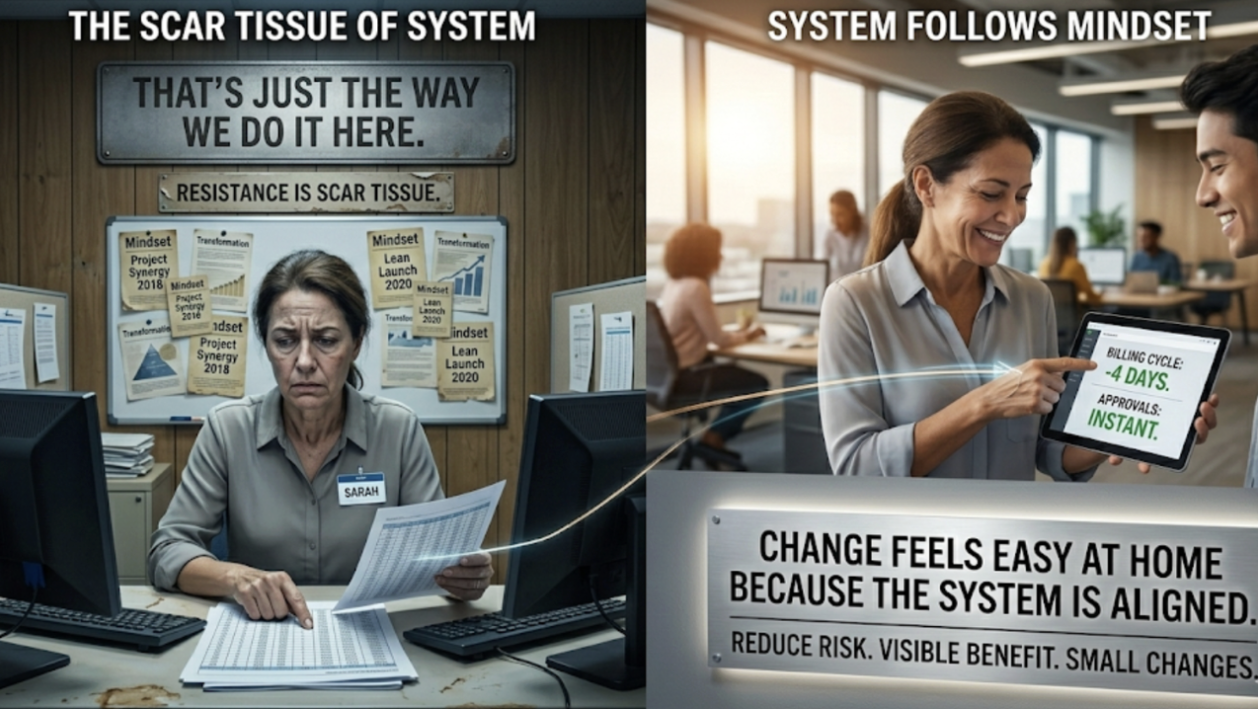
Most Change Isn't a People Problem
We've all heard them. "That system's a nightmare, but if we touch it, it'll break." Or the classic: "People round here won't change" - usually said while someone is manually copying numbers from one spreadsheet into another.
There's humour in it. But there's also truth. Every business has its version of "we've always done it this way." Underneath that statement isn't laziness - it's protection.
Think about your own life. If you decided this weekend to change the wallpaper at home, you wouldn't launch a "Wall Covering Transformation Programme." You wouldn't create a steering committee or run a stakeholder engagement workshop.
Why? Because you've already done the engagement work in your own head - you've decided it's worth it, you've accepted the mess, the disruption, the cost, the effort.
Resistance Is Scar Tissue
When someone says "people round here won't change," what they often mean is:
- The last change made things worse
- The last initiative disappeared without trace
- The last system update created more admin
- The last project exposed mistakes publicly
None of that is irrational. It's behavioural logic. If every decision still escalates upward, if mistakes are punished, if people are measured on activity not outcome - the system rewards caution.
Mindset follows system design. Not the other way round.
You cannot ask for initiative in a structure that penalises it. You cannot ask for ownership if approval is centralised. You cannot ask people to "embrace change" when the personal risk outweighs the visible benefit.
What Actually Shifts Behaviour
When change is announced as a programme, a framework, a transformation - people don't evaluate the vision. They evaluate the risk.
If the perceived risk is high and the visible relief is low, resistance is rational. Not cultural. Rational.
Change becomes easier when one frustration disappears. One bottleneck clears. One recurring issue stops. One approval loop shortens.
So when you hear "That's just the way we do it here" - it might not be stubbornness. It might be scar tissue. Adjust the system and mindset follows. Not overnight, but marginally, consistently, sustainably.
If this resonates, always happy to have a conversation.